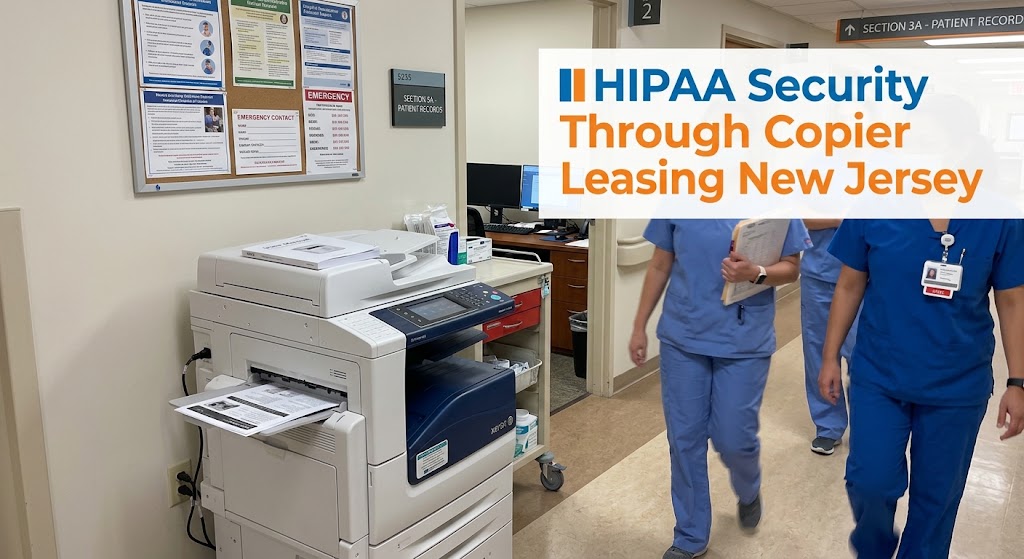
Copier leasing New Jersey can help healthcare and pharmaceutical organizations control equipment costs while protecting sensitive patient and research information, but the lease must address what happens to data stored inside the multifunction printer (MFP). Modern copiers can retain scans, copies, print jobs, address books, authentication records, and other information on internal storage, so a device returned without proper sanitization can create a serious privacy risk. The 2013 Affinity Health Plan case shows why this matters: HHS said Affinity returned multiple photocopiers containing ePHI on their hard drives and agreed to a $1,215,780 settlement involving potential HIPAA violations affecting up to 344,579 individuals.
The goal is not to claim that a particular copier automatically makes an organization HIPAA compliant, because HIPAA compliance depends on an organization’s broader administrative, physical, and technical safeguards. Instead, copier leasing New Jersey should be evaluated as one part of a documented security and risk-management program, with the equipment and service agreement supporting that program. HHS states that risk analysis is foundational to Security Rule compliance and that organizations must evaluate risks to ePHI across electronic media, including hard drives and other storage devices.
What Happens to Patient Data When Returning a Leased Copier in New Jersey?
The Affinity case is one of the clearest real-world warnings about what happens to patient data when returning a leased copier in New Jersey or anywhere else in the United States. HHS reported that Affinity returned multiple photocopiers to a leasing agent without erasing data on their hard drives, potentially exposing the ePHI of up to 344,579 people, and the organization agreed to pay $1,215,780 and undertake corrective actions. The lesson is straightforward: a copier return should be treated as a controlled data-disposal event.
How to Ensure Leased Copiers in NJ Meet HIPAA Data Privacy Regulations?
A practical HIPAA data privacy regulations process should also involve the organization’s compliance, IT, and operations teams before equipment is selected. The lease should identify security responsibilities rather than assuming the equipment provider automatically handles every HIPAA obligation. This matters because HIPAA requires appropriate safeguards, while the exact controls needed depend on the organization’s documented risks and environment.
| Security area | What the healthcare organization should verify |
| Encryption | Whether stored data can be encrypted and how encryption is managed |
| Authentication | Whether users can be required to authenticate before accessing functions |
| Audit trails | Whether print, scan, copy, and administrative activity can be logged |
| Secure printing | Whether jobs can be held until the authorized user authenticates |
| Storage controls | What data is retained and for how long |
| Remote service | How technicians access the device and what controls apply |
| Sanitization | How internal storage is cleared, purged, or destroyed |
| Documentation | Whether the organization receives appropriate completion records |
These controls also make HIPAA data privacy regulations a more manageable operational question. HHS identifies access controls, authentication, encryption, and audit controls among the technical safeguards that can intersect with the Security Rule, while its guidance stresses that organizations should base security decisions on their risk analysis.
Which Security Features Should a Healthcare or Pharma Copier Lease Include?
ePHI security on copiers also depends heavily on controlling who can use the machine and what they can do. Pull-printing, badge authentication, PIN release, role-based access, and automatic logoff can reduce the chance that sensitive pages sit unattended in an open printer tray. HHS identifies authentication and access control as important Security Rule safeguards, while audit controls are designed to record and examine activity in systems that contain or use ePHI.
Core MFP Security Requirements
- Hard-drive or storage encryption
- Automated overwrite or secure deletion
- User authentication
- Badge or PIN release
- Role-based access controls
- Audit logs
- Secure network communication
- Remote-service controls
- Automatic logoff
- End-of-lease sanitization
- Documented administrative procedures
These controls support data encryption copiers NJ buyers should evaluate when sensitive information may be stored locally. Data encryption copiers NJ requirements should include both encryption capability and the organization’s process for managing credentials, keys, firmware, administrator access, and device configuration. HHS notes that encryption decisions should be informed by risk analysis, and its current Security Rule guidance identifies encryption, access controls, audit controls, and authentication as relevant security measures.
What Should the Lease Say About End-of-Lease Copier Data Sanitization?
A practical end-of-lease copier hard drive destruction for NJ pharmaceutical companies clause should reference a recognized media-sanitization process and define acceptable evidence of completion. NIST’s current SP 800-88 Revision 2 describes clear, purge, and destroy sanitization methods and explains that destruction should make data recovery infeasible using state-of-the-art laboratory techniques. For organizations requiring physical destruction, the contract can specify approved destruction procedures and a certificate or other documented record.
What a Strong End-of-Lease Clause Can Address
- Device and storage-media identification
- Approved sanitization method
- Encryption or cryptographic-erasure requirements
- Physical destruction when required
- Chain of custody
- Authorized personnel
- Completion documentation
- Certificate of sanitization or destruction
- Handling of failed or defective storage
- Confirmation before equipment leaves the facility
The same copier hard drive wipe end-of-lease requirement should apply to equipment that is replaced early, traded in, transferred, or removed for service when its storage may contain ePHI. Copier hard drive wipe end-of-lease procedures should never depend solely on an employee remembering to delete files from the touchscreen. For copier hard drive wipe end-of-lease protection, the organization should have a repeatable process that covers the machine’s entire lifecycle.
How Can Healthcare Organizations Reduce Printing Risk and Downtime?
The best managed print services New Jersey approach should reduce downtime without creating unnecessary access to sensitive information. Service technicians may need device-level access during maintenance, so the organization should define how service accounts, remote support, stored documents, and administrator credentials are controlled. Similarly, medical practice MFP leasing should include a process for replacing failed storage and handling equipment that must leave the facility for repair.
Operational Controls Worth Reviewing
- Device monitoring
- Automatic toner alerts
- Preventive maintenance
- Service response targets
- Secure configuration management
- User authentication
- Print-volume reporting
- Device replacement procedures
- Technician access controls
- Storage-media handling
A healthcare organization can also use Secure badge release printing for NJ hospitals and pharma labs to reduce documents being left unattended.
A Safer Approach to Copier Leasing New Jersey
Healthcare and pharmaceutical organizations should view copier leasing New Jersey as more than an equipment-financing decision when MFPs handle ePHI, research data, prescriptions, billing records, or other confidential information. The Affinity Health Plan settlement demonstrates the financial and compliance consequences that can follow when leased copiers are returned without properly addressing information stored on their hard drives.
Clear Choice Technical Services can help medical office managers, pharmaceutical IT directors, and compliance teams evaluate equipment, service, and security requirements before signing a lease. Copier leasing New Jersey should be built around secure workflows and predictable support from day one; call Clear Choice Technical Services at (866) 620-2287 to discuss the organization’s requirements.